


HOTOPRINT has been actively involved in collaborative projects with partners from industry, research institutes and universities. For this commitment to research and development, we were awarded the seal “Innovativ durch Forschung” (Innovative through research) 2022/2023. Here we present two completed projects.

Completed collaborative project
ProgressivKI – safe electronic systems with AI
The German Federal Ministry for Economic Affairs and Energy (BMWi) funded German AI research with 11.2 million euros to develop safe, innovative electronic systems for future vehicle generations. In the progressivKI project, eighteen partners worked together in a consortium coordinated by Robert Bosch Car Multimedia GmbH in Hildesheim, with project management support from edacentrum.
01Objective
The aim of the three-year project, launched on 1 April 2021, was to develop a generalised AI-supported design process for electronic systems in vehicles. On the way to autonomous and electrically powered vehicles, system complexity is increasing significantly. AI methods are intended to help develop functionally safe electronic systems faster, more reliably and more cost-effectively.
02Approach
The project developed a modular AI platform that works flexibly with individual, distributed AI modules via secure, encrypted connectors. Pre-trained AI modules are intended, for example, to significantly reduce the effort required for reviewing schematics and layout data.
03Partners
The consortium covered the entire value chain for the design of electronic systems, including Infineon Technologies, Zuken, Microchip Technology Germany, CELUS, Luminovo, Fraunhofer institutes as well as TU Dortmund, TU Berlin and HSU Hamburg.
Grant number 19A21006A-R
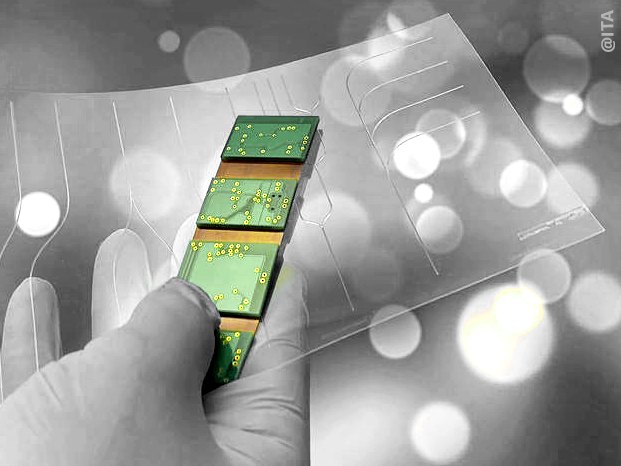
Photo: ITA – Leibniz University Hannover
Completed collaborative project
OptiK-Net – optical networks directly on the PCB
Direct printing and integration of short-range optical networks: electromagnetically compatible high-rate data transmission over short distances.
01Background
Digitalisation and electromobility are leading to a growing demand for electromagnetically compatible data transmission at high rates. In battery and charging technology, voltages of several hundred volts are switched on the PCBs of inverter systems. Optical data transmission is less susceptible to interference there. Autonomous driving also requires sensor data, such as high-resolution camera images, to be transmitted with high bandwidth.
02Printed optical waveguides
For the first time, high-throughput printing processes were to be enabled to print highly functional polymer-based optical waveguides directly and on an industrial scale. Screen, flexographic and gravure printing were investigated for this purpose.
03Integration into the PCB
The printed optical waveguide structures were to be integrated into electrical circuit boards to create an electro-optical rigid-flex assembly. It combines the high integration density of rigid-flex PCBs with the advantages of optical communication: electromagnetic compatibility, high bandwidth and galvanic isolation.
Get in touch – we will be happy to contribute our experience in PCB manufacturing.